MoveTime · sedentary and desk-based work
For the workers most safety programs don't reach.
MoveTime is a desktop application that interrupts prolonged sitting with short, guided movement, made for sedentary and desk-based workers.
The gap in the program
The sedentary half of musculoskeletal risk.
Musculoskeletal disorder (MSD) risk does not stop at the factory door. Desk-based and hybrid work carries its own exposure — and in most organisations, nothing in the safety program addresses it.
Prolonged sitting
Hours held in one position load the lower back and shorten the hip flexors. The exposure is the duration, not any single moment in it.
Repetitive computer work
Keyboard and mouse work loads the wrists, elbows and shoulders at a lower grade than manual handling, and accumulates across a career.
Static cervical and lumbar loading
A screen held at the wrong height keeps the neck in a fixed posture; a chair that does not fit the worker keeps the lumbar spine in one.
Home and hybrid setups
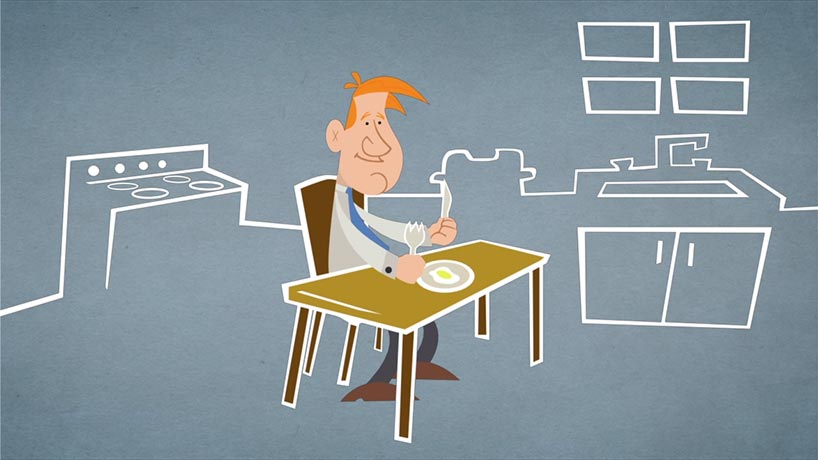
The kitchen table is now a workstation. Home environments rarely match the ergonomic standard of the office, and rarely get reviewed.
The cost is slower than an industrial injury, more diffuse, and harder to trace to a single event, which is why it's so often left out of a program. It's just as real.

The intervention
Move. Mobilise. Activate.
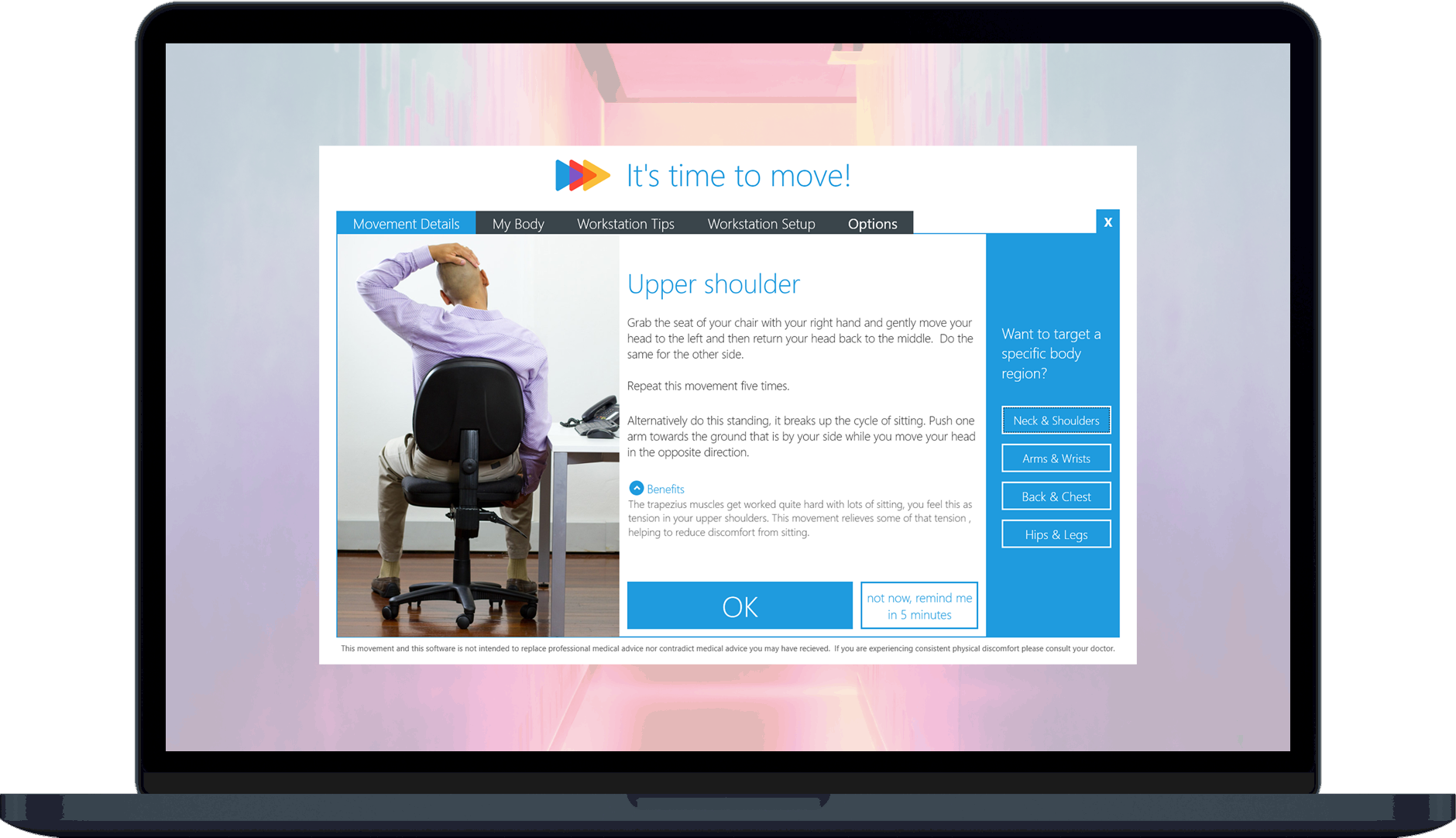
At an interval you set, MoveTime interrupts the work session with one or two short movements targeting the neck, back, shoulders, wrists and hips. Under a minute, at the desk, in normal attire, without equipment — and drawn from a varied rotation, so the prompt does not become wallpaper.
Move
A short change of position that breaks the posture the worker has been holding — standing, reaching, rotating through the spine.
Mobilise
A guided range-of-motion movement for the neck, shoulders, wrists, back or hips — the regions desk work holds still the longest.
Activate
A brief load through the muscles that sitting switches off, so the worker returns to the task warmer than they left it.
Control
Interrupting, on purpose — and on your terms.
A prompt you resent is a prompt you turn off, so MoveTime is built to be welcome: the timing, the working day and the pauses are all yours to set.
- Intervals you choose
- Set the gap between prompts — 30, 45 or 60 minutes are the usual choices. The rhythm is yours, not the application's.
- Work-hour scheduling
- You set your active days and hours, or your administrator sets them for a managed deployment, so nothing arrives after hours.
- Snooze and do not disturb
- A prompt can be deferred, and the application paused through a block of deep work or a meeting. There is no penalty for either.
- Works from install
- The defaults are sensible ones, so the first prompt arrives without any configuration. Everything after that is adjustable.
For organisations
One relationship, both workforces.
Organisation and site licences cover as many workers as you need, with managed deployment across the sedentary population and aggregate engagement reporting to your administrator.
Organisation and site licences
Licence MoveTime for a whole organisation or a single site, for as many workers as you need. Talk to us about the commercial model that fits.
Managed deployment
Roll MoveTime out across your desk-based workforce and set the working-hours defaults centrally, rather than leaving each worker to install and configure it alone.
Aggregate engagement reporting
Your administrator sees engagement across the deployed population, de-identified and in line with your own privacy and consent arrangements, never worker by worker.
Whole-of-workforce coverage
Organisations with mixed workforces run Etiscope for the physical workforce and MoveTime for the sedentary one. Together they address MSD risk across everyone in your organisation — two answers to two different risk profiles, inside one JointAction relationship.
See Etiscope, for the physical workforce →Scope
What MoveTime is not.
MoveTime is an occupational-safety intervention for the musculoskeletal risk of sedentary work. Here's where it stops.
Not a fitness or wellness app
Fitness applications chase cardiovascular health, weight and sleep. MoveTime is calibrated to the musculoskeletal risk of sedentary work.
Not a productivity tool
The prompts interrupt concentration on purpose, for prevention reasons. Better focus may follow; it is not what MoveTime is for.
Not worker monitoring
Managed deployments report engagement in aggregate to your administrator. It isn't designed to watch individual workers.
Not a clinical tool
MoveTime does not diagnose, treat or prescribe. Anyone with a specific condition should see occupational health or a clinician.
Not part of Etiscope
Etiscope assesses physical, manual-handling work. MoveTime is a parallel path for a different workforce and a different risk profile.
Download
Get MoveTime.
Contact us for the macOS and Windows installers, or to talk about an organisation or site licence.